


The Balanced Body Journal
SEPTEMBER
Birthdays, Goals & Awareness Month
September Is A Big Month For Health Awareness
September is home to some of the year's most important health observances. This month we're honoring National Recovery Month, Suicide Prevention Month, Healthy Aging Month, Pain Awareness Month, Prostate Cancer Awareness Month, Ovarian and Gynecological Cancer Awareness Month, and Sickle Cell Awareness Month.
What Are Your Health Goals This Month?
A new month is a fresh chance to check in with yourself. Setting a monthly health goal, even a small one, keeps you moving in the right direction instead of drifting through the year. Progress happens in these smaller windows, not just at New Year's.
September Birthdays
Happy Birthday to all of our September patients!
Thank you for letting us be part of your wellness journey this year. May this next trip around the sun bring you more energy, more clarity, and a body that finally works with you instead of against you.
PEPTIDE SPOTLIGHT, WELLNESS TIP & CORTISOL CHECK

PEPTIDE SPOTLIGHT: GLUTATHIONE
Glutathione is often called the master antioxidant. It supports your liver’s detox pathways, helps reduce oxidative stress, supports a healthy immune response, and is a favorite for patients looking to support energy and skin clarity from the inside out.

WELLNESS TIP
Get 10 minutes of natural sunlight within 30 minutes of waking.
Morning light exposure is one of the simplest, free ways to help set a healthy cortisol rhythm for the entire day—higher when you need it in the morning, lower when it is time to wind down at night.

CORTISOL CHECK
DO YOU KNOW IF YOU HAVE CORTISOL DYSREGULATION?
No recent labs, but the fatigue, the belly fat, the 3am wake ups sound familiar?
Do not guess. Read between the labs. Labs will show you what is actually happening so we can get you taken care of.

The Cortisol Deep Dive
Cortisol is a hormone produced by your adrenal glands that helps your body respond to stress, maintain energy, and regulate important daily functions. Often called the “stress hormone,” cortisol actually plays a much broader role in overall health.

What Exactly Is Cortisol?
Cortisol is your adrenal glands’ stress hormone, and it runs on a daily rhythm, highest in the morning to help you wake up and get moving, lowest at night so you can wind down and sleep. When that rhythm gets disrupted by chronic stress, poor sleep, or overtraining, cortisol stops doing its job well and starts working against you.

How Cortisol Impacts Insulin
Cortisol’s job during a stress response is to raise blood sugar fast, giving you fuel to fight or flee. That is fine for an occasional real threat. But when cortisol stays elevated day after day from chronic stress, your blood sugar stays elevated too, which forces your pancreas to keep pumping out insulin to compensate. Over time, this is one of the quiet drivers behind the same insulin resistance we talked about last month. Cortisol and insulin are tangled together, you cannot fully fix one without addressing the other.

How Cortisol Impacts Hormones
Cortisol is made from the same raw materials your body uses to make progesterone, testosterone, and estrogen. When your body is under chronic stress, it prioritizes making cortisol over making those other hormones, a pattern often called pregnenolone steal. This is a major reason people under long term stress end up with low progesterone, low testosterone, irregular cycles, and thyroid hormone that is not converting properly.

What It Looks Like In Real Life?
Wired but exhausted. Stubborn belly fat that will not respond to diet or exercise. Waking up at 2 or 3 in the morning and not being able to fall back asleep. Getting sick more often. Low libido. Anxiety that feels physical, not just mental. Brain fog. Slower recovery from workouts. If this sounds familiar, your cortisol may be the hidden piece nobody has looked at.

Introducing
The Inner Circle Reset
A 90-Day Intensive Immersion
7 Spots. 90 Days. All In.
This is a small, provider led 90-day cohort, just seven people per group, all-inclusive. Built around GLP-1, LDN, and supplements, with weekly and daily accountability, three 1:1 provider visits, a full body composition scan, and a private group of seven moving through it together.
This is not medication handed to you and left alone, you will learn to live the six pillars of lifestyle medicine, nutrition, movement, sleep, stress resilience, connection, and avoiding risky substances, over the full 90 days, so the change sticks well beyond the program.

Who's This For:
People ready for real change before 2027 arrives. People who have put in the work before and are tired of not seeing the change they deserve. People ready to do the work themselves, guided every step of the way instead of doing it alone. Open to new clients and to established clients who want to try this next.

What's Included:
Your Root Cause Panel labs and a 1:1 Blueprint session before you even start, your titrated GLP-1 protocol, LDN, 90 days of supplements, a full body composition scan, three provider visits on Day 1, 60, and 90, daily accountability check-ins, weekly goal setting, weekly challenges, your Thursday GLP-1 visit and your Thursday Weekly Balance call.

How To Participate:
Message Dr. Spencer directly for more information. She'll fill you in on everything this includes and whether it's right for you.
LAB INSIGHT OF THE MONTH

TOTAL CHOLESTEROL ALONE DOES NOT TELL THE WHOLE STORY
Most people only ever see total cholesterol and LDL on a standard panel, and both can look completely fine while real risk is hiding underneath. That is where Apolipoprotein A and Apolipoprotein B come in.

LDL VS APOB, WHAT IS THE DIFFERENCE
LDL is a measurement of how much cholesterol is being carried in your blood. ApoB measures the actual number of particles doing the carrying.
You can have a normal LDL number made up of many small, dense particles, which is a much higher risk pattern than a smaller number of large particles. ApoB tells us what LDL alone cannot, how many of those particles are actually out there.

APOA, THE PROTECTIVE SIDE
Lipoprotein(a), or Lp(a), is a separate particle from LDL and ApoB, and it is almost entirely determined by your genetics, not your lifestyle. That means diet, exercise, and even most medications will not move this number. Elevated Lp(a) raises cardiovascular risk on its own, independent of everything else on your cholesterol panel, which is exactly why it gets missed.
You can have perfect LDL, perfect ApoB, and still be carrying real risk if Lp(a) is high.

WHAT A STATIN ACTUALLY DOES
Statins work by blocking an enzyme in your liver that your body uses to produce cholesterol, which prompts your liver to pull more LDL out of your bloodstream.
What statins do not do is address why your cholesterol is elevated in the first place. If the real driver is insulin resistance, inflammation, or a hormone imbalance, a statin can lower the number on paper while the underlying problem keeps running in the background, which is exactly why some patients feel like the numbers just will not move no matter what they take.
BRINGING CHOLESTEROL DOWN NATURALLY
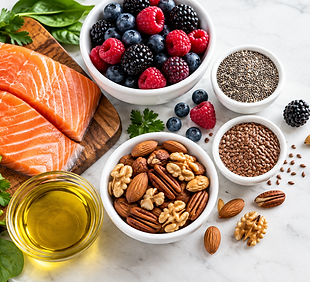
Supporting insulin sensitivity, reducing inflammation, increasing fiber intake, supporting healthy thyroid function, regular movement, omega 3s, and managing cortisol all play a real role in bringing cholesterol back into a healthy, functional range.

CHOLESTEROL IS NOT THE ENEMY
It is the raw material your body uses to make cortisol, estrogen, progesterone, testosterone, and vitamin D.
Managing cholesterol is not about eliminating it, it is about making sure your body is using it the way it is designed to.